

Use our compound interest calculator to estimate how your money could grow over time. Enter your starting balance, expected interest rate, investment period, and compounding frequency to calculate an estimated future value. You can also add regular contributions to see how additional deposits may affect your results. In addition, the calculator separates your original principal, contributions, and interest earned. As a result, you can see where your final balance comes from. Try different amounts, rates, and time periods to compare scenarios and understand how compound growth can affect your money over the long term.
How Does Compound Interest Work?
Compound interest allows your money to earn interest on both the original balance and previously earned interest. For example, suppose you start with $1,000. After the first compounding period, the account adds interest to your balance. Then, the larger balance can earn more interest during the next period. Over time, this process can increase the effect of compounding. However, the final result depends on several factors, including your starting amount, interest rate, compounding frequency, and investment period. In addition, regular contributions can increase the amount of money available for future growth.
How to Calculate Compound Interest
You can calculate compound interest using four main values: the initial amount, annual interest rate, compounding frequency, and number of years.
Step 1: Enter the initial amount you want to calculate.
Step 2: Convert the annual interest rate from a percentage into a decimal.
Step 3: Choose how many times interest compounds each year.
Step 4: Enter the number of years.
Step 5: Apply the compound interest formula to calculate the future value.
For example, if you invest $1,000 at 5% annually for 10 years and compound the interest once each year, you get an estimated balance of $1,628.89. Therefore, the investment earns approximately $628.89 in compound interest.
Compound Interest Formula
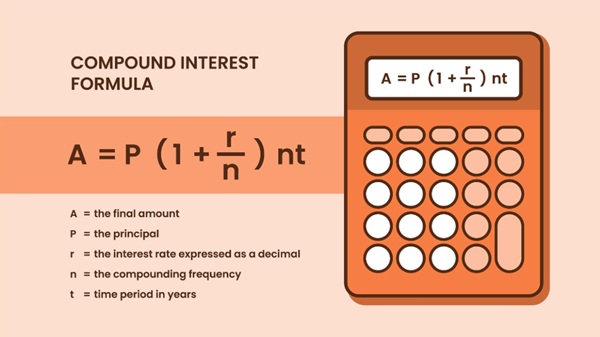
The standard compound interest formula is:
A = P(1 + r/n)^(nt)
Each variable represents a different part of the calculation:
A = final amount
P = initial principal
r = annual interest rate in decimal form
n = number of compounding periods per year
t = number of years
For example, consider an initial investment of $1,000 with a 5% annual interest rate for 10 years and annual compounding.
A = 1,000(1 + 0.05/1)^(1 × 10)
This calculation produces approximately $1,628.89. Therefore, the investment earns about $628.89 in interest. If you make regular contributions, you can include those deposits to estimate their additional effect on the final balance.
Frequently Asked Questions
What does a compound interest calculator do?
A compound interest calculator estimates how money could grow when you earn interest over a specific period. You can enter factors such as the starting amount, interest rate, time period, and compounding frequency.
What information do I need to calculate compound interest?
You typically need an initial principal, annual interest rate, number of years, and compounding frequency. For a more detailed estimate, you can also include regular contributions.
Does compounding frequency affect the result?
Yes. The compounding schedule can change the estimated future value. For example, monthly and annual compounding can produce different results when the other assumptions remain the same.
Can I include regular contributions?
Yes. Regular contributions can increase the amount available for future growth. Therefore, adding monthly or other recurring deposits can change the estimated final balance.
Are compound interest calculator results guaranteed?
No. The calculator provides an estimate based on the information you enter. Actual savings or investment results can vary because interest rates, fees, taxes, and other factors may affect the final amount.