
How to Calculate Compound Interest Step by Step. Working out compound interest is mainly about understanding how your balance changes over time. The calculation can be done with a formula, but you do not need to be good at math to understand the result.
What You Need
Before starting, check the details of the account or investment:
- The money you put in
- The interest rate
- How often interest is added
- How long you plan to keep the money there
These details are enough for a basic estimate.
Follow the Balance Over Time
Compound interest works differently from a fixed return.
When interest is added to your balance, the new total becomes the starting point for the next period. The process then repeats.
For example, if your balance increases after one month, the following month’s calculation is based on the new balance rather than only on the money you originally deposited.
This is the main idea behind compound growth.
Check the Interest Schedule
Look at how the account calculates interest. It may be added yearly, quarterly, monthly, or according to another schedule.
The timing matters because it determines when interest becomes part of your balance.
If you are comparing two accounts, check their full terms instead of looking only at the advertised percentage.
Use a Calculator
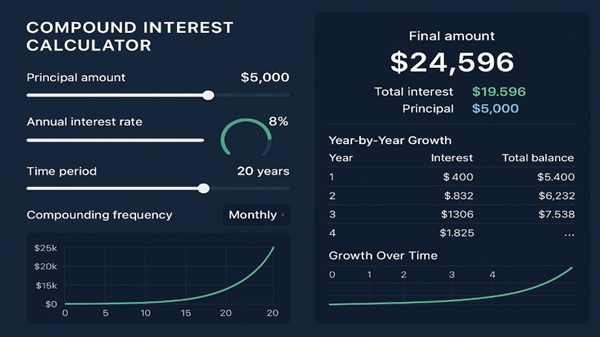
A compound interest calculator is often the quickest option.
Enter the starting balance, rate, time period, and compounding schedule. If you plan to add money regularly, choose a calculator that supports additional contributions.
You can then change the numbers to see different possible outcomes.
For instance, try a shorter and longer saving period. You can also compare what happens when you increase your regular deposit.
Don’t Forget Real-Life Changes
A calculation is based on the information you enter. Real accounts may work differently over time.
An interest rate can change. You may withdraw money, add more savings, or pay account fees. Investment returns can also move up and down.
Because of this, a compound interest calculation should be treated as an estimate based on specific assumptions.
A Quick Example
Imagine you have money in an account and leave it untouched for several years.
At first, the growth may seem small. As the balance gets larger, each new period starts with a different amount.
That gradual change is what makes compound interest useful for understanding long-term savings.
Final Thoughts
The easiest way to calculate compound interest is to start with the account information and then follow how the balance grows from one period to the next.
A calculator can handle the mathematics, while understanding the process helps you make sense of the final number. When checking your result, pay attention to the rate, time period, and interest schedule.