
Compound interest is one of the simplest ways to understand how money can grow over time. Whether you are saving money, comparing investment options, or simply trying to understand how interest works, knowing the compound interest formula can help you estimate how much your money may be worth in the future.
The good news is that you do not need an advanced finance background to understand it. Once you know what each part of the formula means, calculating compound interest becomes much easier.
What Is Compound Interest?
Compound interest is interest earned on both your original money and the interest that has already been added to your balance.
For example, imagine you deposit $1,000 into a savings account that earns 5% interest per year.
After the first year, you earn $50, so your balance becomes $1,050.
In the second year, the 5% interest is calculated on $1,050 rather than only on the original $1,000. That means you earn $52.50 instead of $50.
Your balance then becomes $1,102.50.
This process continues each time interest is added. As the balance grows, there is more money available to earn interest.
That is the basic idea behind compound interest growth.
What Is the Compound Interest Formula?
The standard compound interest equation is:
A = P(1 + r/n)^(nt)
Although the formula may look complicated at first, each letter has a simple meaning.
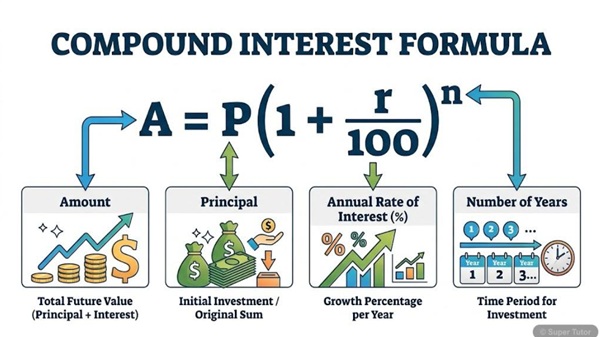
What the Variables Mean
A = the final amount
This is the total balance after the specified period.
P = the principal amount
This is the money you start with.
r = the annual interest rate
The interest rate should be written as a decimal. For example, 6% becomes 0.06.
n = the number of times interest is compounded per year
For example, monthly compounding uses 12, while quarterly compounding uses 4.
t = the number of years
This represents how long the money remains in the account or investment.
Once these values are known, you can use the formula to calculate the potential future value.
How to Calculate Compound Interest
Let’s walk through a straightforward compound interest calculation.
Suppose you invest $2,000 at an annual interest rate of 6%, compounded once a year, for 5 years.
We have:
- P = $2,000
- r = 0.06
- n = 1
- t = 5
Put those numbers into the formula:
A = 2,000(1 + 0.06/1)^(1 × 5)
The final balance is approximately $2,676.45.
To find the amount of interest earned, subtract the original principal:
$2,676.45 − $2,000 = $676.45
So, after five years, the account would have approximately $2,676.45, assuming the interest rate remains unchanged and there are no additional deposits, withdrawals, fees, or taxes.
Why Does Compound Interest Grow Over Time?
One of the most important things to understand about compound interest is the role of time.
When you earn interest, that interest becomes part of your balance. The larger balance can then earn additional interest.
For example:
Starting money → interest earned → larger balance → more interest
The process repeats over time.
During the first few years, the difference may not seem dramatic. As more interest accumulates, however, the amount available to generate additional interest becomes larger.
This is why compound interest over time can have such a significant effect on long-term savings and investments.
How Does Compounding Frequency Affect Growth?
The frequency at which interest is added to an account can also affect the final balance.
Common compounding frequencies include:
- Annually — 1 time per year
- Semi-annually — 2 times per year
- Quarterly — 4 times per year
- Monthly — 12 times per year
- Daily — commonly 365 times per year
The variable n in the formula represents this frequency.
For example, if interest compounds monthly, you would use 12 for n.
With the same stated annual rate and other conditions, more frequent compounding generally results in a slightly higher final balance because interest is added to the account more often.
The difference may be relatively small over a short period, but it can become more noticeable over many years.
Monthly Compound Interest Explained
Monthly compound interest is particularly common in financial calculations.
When interest compounds monthly, the annual rate is divided into 12 periods. The interest is then calculated and added to the balance each month.
For example, suppose you have $5,000 earning 6% annually with monthly compounding.
The formula would use:
P = $5,000
r = 0.06
n = 12
The calculation therefore reflects 12 compounding periods for every year the money remains invested.
A compound interest calculator can perform this calculation quickly, but understanding the formula helps you see where the result comes from.
Compound Interest vs. Simple Interest
Compound interest is different from simple interest because the two methods treat previously earned interest differently.
With simple interest, interest is calculated using the original principal.
The simple interest formula is:
A = P(1 + rt)
With compound interest, previously earned interest becomes part of the balance used in future calculations:
A = P(1 + r/n)^(nt)
Consider a $1,000 balance earning 5% per year.
With simple interest, the interest is based on the original $1,000.
With compound interest, the balance can increase after each compounding period, so future interest can be calculated on a larger amount.
Over a long period, this difference can become substantial.
What Factors Affect Compound Interest?
Several factors influence the amount your money can accumulate.
Starting Principal
The larger your initial deposit, the more money there is available to earn interest.
Interest Rate
A higher rate generally leads to greater growth when all other conditions remain the same.
Time
Giving your money more time to compound can significantly affect the final balance.
Compounding Frequency
Monthly, quarterly, and annual compounding can produce different results even when the stated annual rate is the same.
Additional Contributions
If you regularly add money to your account, those new contributions can also have an opportunity to earn interest.
This is important because real savings plans often involve regular deposits rather than a single initial investment.
What Happens When You Add Money Every Month?
The standard compound interest formula assumes a single initial deposit.
In real life, you may contribute $50, $100, or another amount every month.
For example, imagine starting with $1,000 and then adding $100 each month. Your balance can grow from both the original deposit and your recurring contributions.
Each contribution has its own opportunity to earn interest once it enters the account.
When calculating compound interest with regular contributions, a different formula is generally used because the deposits are made at different times.
This is one situation where an online calculator can be useful because it can account for the starting balance, contribution amount, interest rate, compounding schedule, and investment period together.
How Long Does Compound Interest Take to Make a Difference?
There is no single answer because the result depends on the principal, interest rate, compounding frequency, and time period.
A $10,000 investment earning 3% will behave differently from a $10,000 investment earning 8%.
Likewise, leaving money invested for 30 years will produce a different result from leaving it for only 5 years.
Rather than focusing on one number, it is often more useful to compare several scenarios.
You can change the investment period, interest rate, or starting balance and see how each change affects the future value.
This is one of the easiest ways to understand the practical effect of compound growth.
Common Mistakes When Calculating Compound Interest
Even though the formula is straightforward, a few small errors can produce very different results.
Using the Wrong Interest Rate Format
A 5% annual rate should be entered as 0.05, not 5.
Forgetting the Number of Compounding Periods
If interest compounds monthly, use 12 for the value of n.
Mixing Months and Years
The standard formula uses years for t. Make sure your time period matches the formula.
Confusing Interest With the Final Amount
The value of A represents the total accumulated balance.
To find only the interest earned, use:
Interest earned = A − P
Ignoring Real-World Costs
A mathematical calculation may not include account fees, taxes, withdrawals, changing interest rates, or other costs.
As a result, the actual amount you receive may differ from a theoretical calculation.
When Is a Compound Interest Calculator Useful?
You can calculate compound interest by hand, but a compound interest calculator can make it easier to compare different scenarios.
For example, you might want to see:
- How much $1,000 could grow over 10 years
- What happens when the interest rate changes
- The difference between monthly and annual compounding
- How much longer-term saving could affect the balance
- How regular contributions change future growth
A calculator is especially useful when you want to test several combinations without manually repeating the entire calculation.
However, knowing the underlying formula is still valuable. It allows you to understand what the calculator is actually calculating rather than treating the final number as a black box.
Frequently Asked Questions
What is the formula for compound interest?
The standard formula is A = P(1 + r/n)^(nt). It calculates the accumulated value of an initial amount when interest compounds at regular intervals.
How do you calculate compound interest?
First, identify the principal, annual interest rate, compounding frequency, and number of years. Convert the interest rate into decimal form and enter the values into the formula. Subtract the original principal from the final amount if you want to find the interest earned.
Is compound interest better than simple interest?
The two methods work differently. Compound interest includes previously accumulated interest when calculating future growth, while simple interest uses the original principal. Which method applies depends on the financial product or situation.
Does compound interest grow faster over time?
Compound growth can accelerate because previously earned interest becomes part of the balance. The longer the money remains invested or deposited, the more compounding periods it has to potentially generate additional growth.
Does monthly compounding make a big difference?
Monthly compounding can produce a higher ending balance than annual compounding when the stated annual rate and other conditions are the same. The size of the difference depends on the rate, starting balance, and length of time.
Final Thoughts
The compound interest formula is a useful tool for understanding how money can grow when interest is repeatedly added to a balance.
The formula itself is:
A = P(1 + r/n)^(nt)
You do not need to memorize every detail immediately. The most important thing is to understand the role of the four main factors: your starting amount, interest rate, compounding frequency, and time.
Time can be particularly important because each period gives accumulated interest another opportunity to become part of the balance.
Whether you are estimating savings growth, comparing investment scenarios, or simply learning how interest works, understanding compound interest gives you a clearer picture of what can happen to money over time.
Keep in mind that the formula provides a mathematical estimate. Actual financial results can vary because rates, fees, taxes, contributions, withdrawals, and account terms may change.