
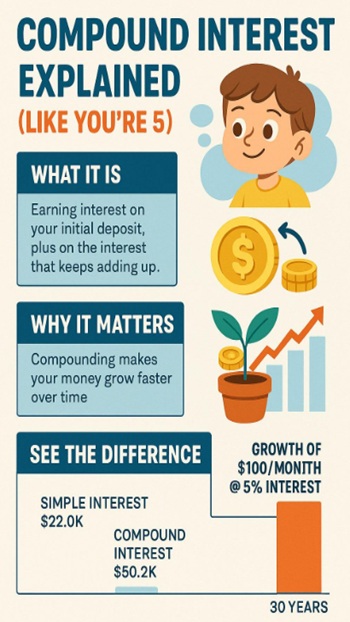
Compound interest is a simple idea that can have a big effect on savings over time. Instead of earning interest only on the money you originally put in, you can also earn interest on the interest that has already been added to your balance.
This process may seem complicated at first, but the basic idea is easy to follow. Once you understand how the balance changes from one period to the next, compound interest becomes much clearer.
Introduction to Compound Interest
Imagine putting money into a savings account. After a certain period, the account adds interest to your balance. Your total is now slightly higher than before.
During the next period, interest can be calculated using that new balance. The process continues as long as the money remains in the account.
This is the main difference between compound interest and simple interest. Simple interest generally uses the original amount when calculating the return. Compound interest allows previously earned interest to become part of the balance.
The longer the money stays in place, the more opportunities there are for this process to continue.
Key Features of Compound Interest
Growth Over Time
Time is an important part of compound growth. The difference may seem small during the early stages, but it can become more noticeable over a longer period.
For example, money kept in an account for ten years has more opportunities to accumulate interest than money kept there for only one year.
The starting balance and interest rate also matter, so the final result will be different for every situation.
Compounding Frequency
Interest can be added according to different schedules. Some accounts compound annually, while others may compound monthly, quarterly, or daily.
The compounding frequency tells you how often interest is added to the account.
When comparing savings products, it is useful to check both the interest rate and how often the interest is compounded. Looking at the rate alone may not give you the complete picture.
Regular Contributions
Compound growth can also apply when you continue adding money to your account.
For example, you might make a deposit every month. Each deposit enters the account at a different time, so each one has a different opportunity to earn interest.
A compound interest calculator that includes regular contributions can help estimate the possible future balance in this situation.
How Compound Interest Is Calculated
A common formula for a basic compound interest calculation is:
The formula uses the starting amount, interest rate, and number of periods to estimate a future value.
You do not need to memorize every part of the equation to understand the concept. What matters is knowing that the balance can change after each period as interest is added.
For more detailed situations, such as monthly deposits or different compounding schedules, a calculator can make the calculation easier.
Frequently Asked Questions
Is compound interest the same as simple interest?
No. Simple interest generally uses the original principal, while compound interest can include previously earned interest when calculating future growth.
Why is time important with compound interest?
A longer period gives the balance more opportunities to earn and accumulate interest. This can make the effect more noticeable over time.
Can I calculate compound interest without a calculator?
Yes. A basic calculation can be done using the appropriate formula. A calculator is simply more convenient when several factors are involved.
Does monthly compounding change the result?
It can. The frequency at which interest is added affects how the balance is calculated, so monthly and annual compounding may produce different results.
In Simple Terms
Compound interest is best understood as a repeating cycle. Money earns interest, that interest becomes part of the balance, and the larger balance can continue to grow.
The final result depends on the starting amount, interest rate, compounding schedule, and time. Understanding these basic factors makes it easier to see how savings can change over the years and why compound growth is important for long-term financial planning.